By Ján Morovič
The fundamentally relational character of Nature can be discovered not only in how the parts that compose it interact, but also in the way that humans and many other organisms perceive it. Already at the level of our sensory experiences, we have evolved to favor relationships among the objects in our environment over their individual properties. Instead of seeing each object in a way that is a consequence of its own physical makeup, our eyes and brain emphasise how the appearances of objects relate to each other.
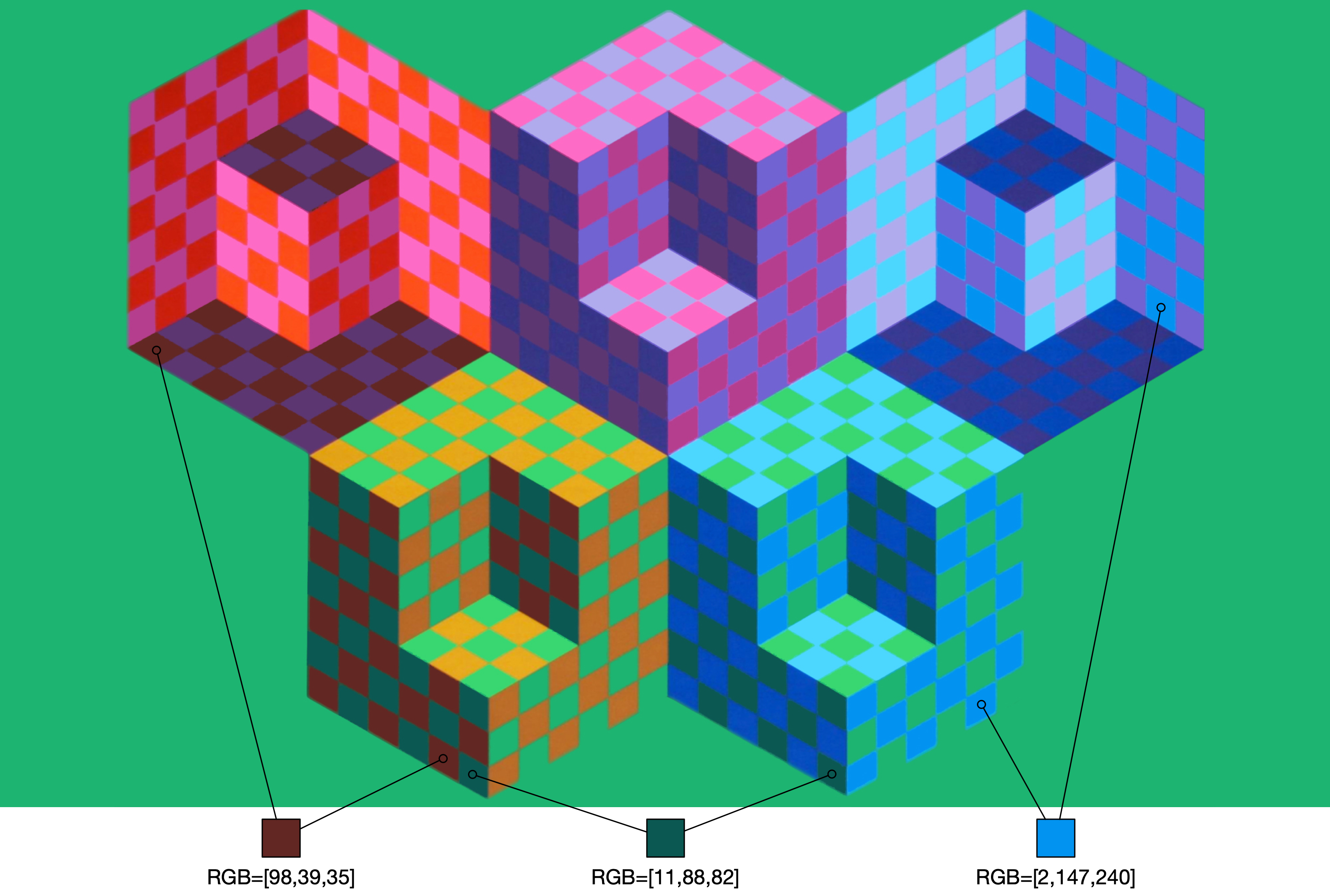
A typical example here is the phenomenon called simultaneous contrast, where the appearance of a surface changes depending on whether it is surrounded by one color or another. In the image at the top of this post there are several sets of squares that have matching physical properties (i.e., they are set to have the same red, green and blue (RGB) values for their pixels), yet they are seen as having different colors. E.g., for the pair of green squares at the centre of the image (with RGB=[11,88,82]), the one on the left looks brighter than that on the right, because it is surrounded by darker colors.
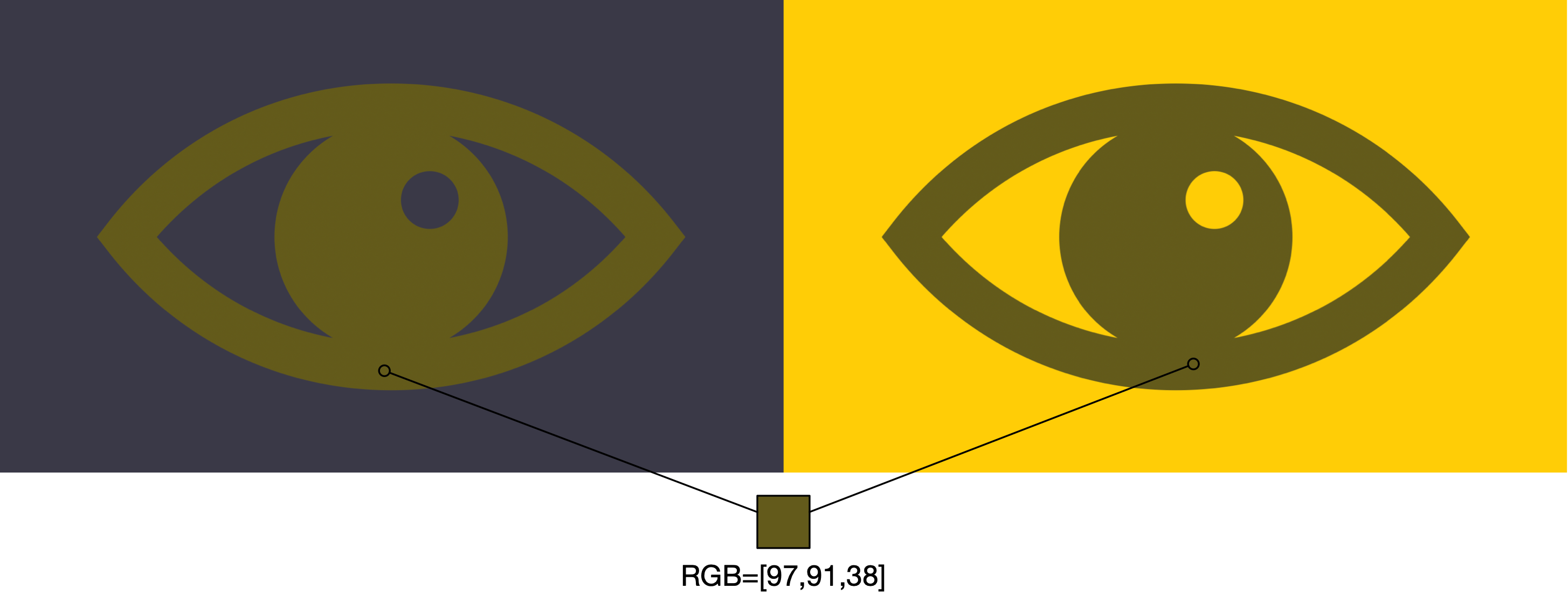
While a common response to this fact about human vision is to call it an illusion, another, physiologically more accurate, characterization is to recognise that it is simply a consequence of how our eyes and brain respond to light. There, the signal triggered in the retina by light-sensitive cells called cones proceeds through a series of successive cell layers where it is not the intensity of response to individual parts of an environment that is passed along to the brain, but instead an amplified difference between intensity at the center versus surround of a part of the retina. Such neural processing already in the eyes, called lateral inhibition, results in it not being an object’s properties that determine perceived brightness, but its relationship with the rest of an environment.
References
Yeonan-Kim J, Bertalmío M (2016) Retinal Lateral Inhibition Provides the Biological Basis of Long-Range Spatial Induction. PLoS ONE 11(12): e0168963. https://doi.org/10.1371/journal.pone.0168963
 Wonderverse
5 Comments Add yours